Posts

Highlights of the 2020 Law - Individuals

Image
As usual, this year brings a new batch of tax laws for business and individual tax returns.  This post will outline some of the major changes for individuals .  If you are looking for business tax changes you can go here. Article Highlights Economic Impact Payments - First and Second Round Educator Expense  Unemployment Assistance  Earned Income Tax Credit & Child Tax Credit Cash Charitable Contributions for Non-Itemizers  Charitable Contributions for Itemizers Flexible Spending Arrangements Carryover  Reduction in Medical Deduction AGI Floor  Education Credits   Volunteer Firefighters and Emergency Medical Responders Discharge of Qualified Principal Residence Indebtedness Student Loans Mortgage Insurance Premiums Housing Relief  Energy Efficient Home Improvement Credit  2-Wheeled Plug-In Electric Vehicle Credit (Motorcycles) Alterative Fuel Vehicle Refueling E...

Highlights of the 2020 Law - Businesses

Image
 As usual, this year brings a new batch of tax laws for business and individual tax returns. This post will outline some of the major changes for businesses . If you are looking for individual tax changes you can go here. Article Highlights Paycheck Protection Program (PPP) and Frequently Asked Questions Employee Retention Tax Credit Business Meals Employer-Provided Educational Assistance  Extension o Deferred Payroll Taxes Depreciation for Residential Rental Property NOL Rules for Farming Losses Work Opportunity Tax Credit Credit for Alternative Fuel Vehicle Refueling Equipment Credit for Fuel Cell Vehicles On December 27, 2020, President Trump signed the Consolidated Appropriations Act, 2021 (CAA) into law.  The CAA contains both the COVID-Related Tax Relief Act of 2020 (COVIDTRA) and the Taxpayer Certainty and Disaster Tax Relief Act of 2020 (TCDTR).  The entire text of the Consolidated Appropriations Act of 2021--all 5,593 pages--can be found  here . This po...

Employee Retention Credit - Update and What to Know for Your Business

Image
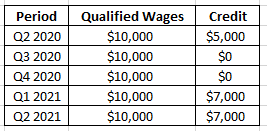
Back in 2020, Congress passed the Cares Act in order to provide relief for those businesses and individuals suffering from the negative effects that COVID was having on the economy. Within the Cares Act there was a credit called the Employee Retention Credit (ERC). Many taxpayers ignored this credit because they were prohibited from claiming the ERC if they applied for and received a Payroll Protection Program (PPP) loan.  Packed inside the thousands of pages of the Consolidated Appropriations Act, 2021 (CAA) passed December 20, 2020 were some favorable updates to the ERC. Two of the most notable changes are... The ERC is extended through June 20, 2021. The ERC is now available retroactively in 2020 to businesses that took a PPP whereas previously it wasn't.  This means that if you did not consider the ERC in 2020 (or were not eligible to consider the ERC because you took a PPP loan), you now have an opportunity to go back and claim the ERC on 2020 wages and receive a refundab...

Requesting A Tax Return Extension: Facts and Myths

Have you ever filed a tax extension? Or have you been worried about the implications of having to do so? Then read below on some of the common facts and myths regarding tax extensions. Statement #1: Taxpayers can get an automatic six-month extension from the IRS. FACT! Not ready to file on April 15? Don’t worry! We file a six-month extension that extends the deadline to file to October 15. For business returns, the original deadline is March 15 and the extended deadline is September 15. NOTE: For the 2020 filing season, the April 15 deadline was automatically moved to July 15, due to COVID-19. Statement #2: An extension also extends my time to pay tax owed. MYTH! This is incorrect! While you can file an extension to file by October 15, your tax liability is owed on April 15. Thus, if you wait to pay until later on in the year (whether that be May or October 15), you’ll owe some interest and penalties on top of the tax liability due. That’s why it’s always best to t...

Self-Employed & Taxes: Schedule C vs S Corporation

Image
Are you self-employed and want to save on self-employment taxes ? Then becoming an S Corporation might be a great option for you! Below we will go over the basic taxation you will see as a Schedule C versus an S Corporation, outline when it makes sense to become an S Corporation, and discuss how to become an S Corporation. Note: Income taxes are the same under either scenario, so we will only be comparing PAYROLL taxes. To see the blog on comparing taxation as a W-2 employee and self-employed on Sch C, click here . PAYROLL TAXES USING SCHEDULE C Whenever you are self-employed reporting your earnings on Schedule C, you pay 15.3% of self-employment (SE) taxes on your net income. Why? Because you aren’t on payroll (like a traditional W-2 employee) but are still required contribute towards the Social Security and Medicare systems. (Note that the Social Security part of the SE tax is 12.4% maxed at $137,700 [for 2020].) EXAMPLE FOR SCHEDULE C Let’s say that you have ...

Tax Differences: Employee vs Self-Employed (on Sch C)

Image
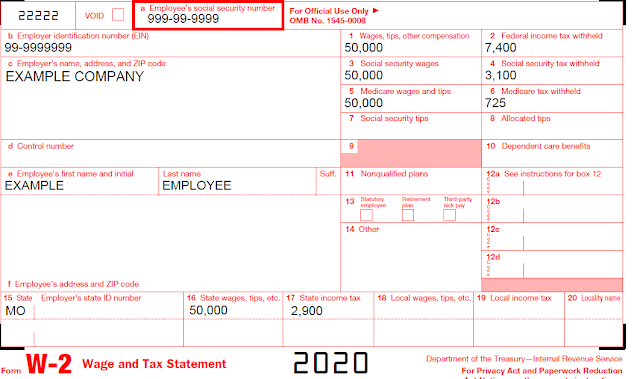
Have you recently transitioned from being an employee of company to being self-employed (or vice versa)? Or are you considering such a transition? In this post, we will explore the main tax differences of being an employee versus being self-employed (with earnings reported on Schedule C) that you NEED to know. Or check out our video on the same topic here . EMPLOYEE & TAXES As an employee of a company, you should receive a Form W-2. You may or may not realize exactly what this form, or your paychecks each pay period, say about taxes. So let’s dive into that. 😊 First, we need to discuss that there are two main types of taxes reported on Form W-2/paystubs. FICA (Social Security & Medicare) taxes – 7.65% deducted from each paycheck (usually you will NOT get this back at all) Note: The Social Security 6.2% is only accessed on the first $137,700 (for 2020) of wages Did you know… Your employer also has a separate 7.65% they are paying for FICA taxes on your pay. ...