Posts

Showing posts matching the search for reasonable

S-Corporations and the Reasonable Wage Requirement

Image
One of the top audit risks for S corporations is salary and wages paid to officers of the corporation.  S corporations have many advantages, tax and legal, as long as you follow the rules.  So if you are considering an S corporation for your business, here is what you need to know on reasonable compensation and S corporations: Reasonable Compensation The fastest way to get audited as an S corporation is to file an 1120S with no amount showing on Form 1120S Line 7 "Compensation of Officers." It is assumed by the IRS that no one works for free, and so the IRS has said over and over again that officers of the corporation must receive wages  (reported on line 7). As an owner-employee of the S corporation, you must pay yourself a salary, and pay payroll taxes on your salary, even if the business is losing money. You don't have to pay yourself a high salary, but it must be a "reasonable amount" according to the IRS. Reasonableness can be interpreted in d...

Self-Employed & Taxes: Schedule C vs S Corporation

Image
Are you self-employed and want to save on self-employment taxes ? Then becoming an S Corporation might be a great option for you! Below we will go over the basic taxation you will see as a Schedule C versus an S Corporation, outline when it makes sense to become an S Corporation, and discuss how to become an S Corporation. Note: Income taxes are the same under either scenario, so we will only be comparing PAYROLL taxes. To see the blog on comparing taxation as a W-2 employee and self-employed on Sch C, click here . PAYROLL TAXES USING SCHEDULE C Whenever you are self-employed reporting your earnings on Schedule C, you pay 15.3% of self-employment (SE) taxes on your net income. Why? Because you aren’t on payroll (like a traditional W-2 employee) but are still required contribute towards the Social Security and Medicare systems. (Note that the Social Security part of the SE tax is 12.4% maxed at $137,700 [for 2020].) EXAMPLE FOR SCHEDULE C Let’s say that you have ...

What's New For The 2020 Tax Filing Season

Image
Filing taxes last year was a nightmare not just for you but for us and the IRS too.  This year might not be much better.   Here’s why: first, the IRS is still working to issue guidance for the changes to the tax code they signed into law more than two years ago and second, Congress passed a series of tax breaks late in 2019 that will require the IRS and tax software providers to revise forms at the last minute.   If you are interested in learning more about what’s happened since we last met, grab your coffee and read at your leisure. J Further Consolidated Appropriations Act In the last few weeks of 2019 Congress produced its most significant tax package of the year as part of the Further Consolidated Appropriations Act, 2020 (FCAA). The Act includes the revival of expired or expiring tax breaks mostly through 2020.  Many of these tax breaks expired after 2017 but Congress retroactively extended them back to January 2018.  This mea...

Greene County ARPA Assistance - Apply by 5/31/22

Image
Greene County has received a total of $56.9 million from the American Rescue Plan Act (ARPA) and has allocated $8 million of these funds for small business ARPA applications. Greene County will grant these funds over four funding rounds expected to take place during 2022 & 2023, with around $2 million being awarded in each round. The first application deadline ends on May 31, 2022 , so if you believe you qualify for the ARPA Small Business Fund grant, please fill out your application as soon as possible (see application process below). ARPA FEATURES The ARPA grants are awarded to recipients based on (1) number of current employees in your business and (2) whether your business operates out of a rented or owned retail, office, warehouse, or operating space. You will have to be able to demonstrate that your business has been negatively impacted due to Covid in order to qualify for any Greene County ARPA assistance (see application process below). The program automatically has ...

Tax Differences: Employee vs Self-Employed (on Sch C)

Image
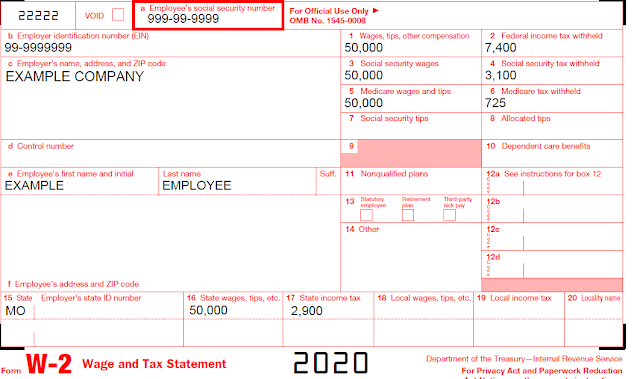
Have you recently transitioned from being an employee of company to being self-employed (or vice versa)? Or are you considering such a transition? In this post, we will explore the main tax differences of being an employee versus being self-employed (with earnings reported on Schedule C) that you NEED to know. Or check out our video on the same topic here . EMPLOYEE & TAXES As an employee of a company, you should receive a Form W-2. You may or may not realize exactly what this form, or your paychecks each pay period, say about taxes. So let’s dive into that. 😊 First, we need to discuss that there are two main types of taxes reported on Form W-2/paystubs. FICA (Social Security & Medicare) taxes – 7.65% deducted from each paycheck (usually you will NOT get this back at all) Note: The Social Security 6.2% is only accessed on the first $137,700 (for 2020) of wages Did you know… Your employer also has a separate 7.65% they are paying for FICA taxes on your pay. ...